
Stop Counting Bike Spaces. Start Planning for Cyclists.
Most bike parking rules start with a formula, like a set number of spaces per suite. That’s easy to check on a drawing. It can’t tell you how many people will actually ride and park. This article looks at why bike parking requirements should reflect location and real demand, and why cities should go back and measure what gets used.
Key Takeaways
- Unlike bike parking spaces, a city cannot mandate cyclists.
- Vancouver’s base rule requires 1.5 to 3 secure bike spaces per suite, wherever the building is.
- We’ve seen as little as 25% of installed bike parking in use after occupancy.
- Bike rooms that meet code but don’t work get torn out, sometimes within five years.
- Cities should measure what gets used and adjust the rules.
The Problem With Bike Parking Requirements
A city can mandate 1,000 bicycle spaces. It cannot mandate 1,000 cyclists.
Most cities set bike parking with a ratio. In Vancouver, a new apartment building needs 1.5 secure bike spaces for every suite under 65 m², 2.5 for suites from 65 to 105 m², and 3 for anything larger (Parking By-law, Section 6.2.1.2).
A 200-suite tower of smaller units needs 300 secure spaces, plus 11 visitor spaces, whether it sits on a protected bike route or next to a highway on-ramp. Site-specific zoning can change the number, but the starting point is the suite count.
The appeal of a formula is obvious. It’s consistent, simple to apply and easy to check on a drawing. But it tells you how many spaces to draw, not whether anyone will use them.
What We See After Occupancy
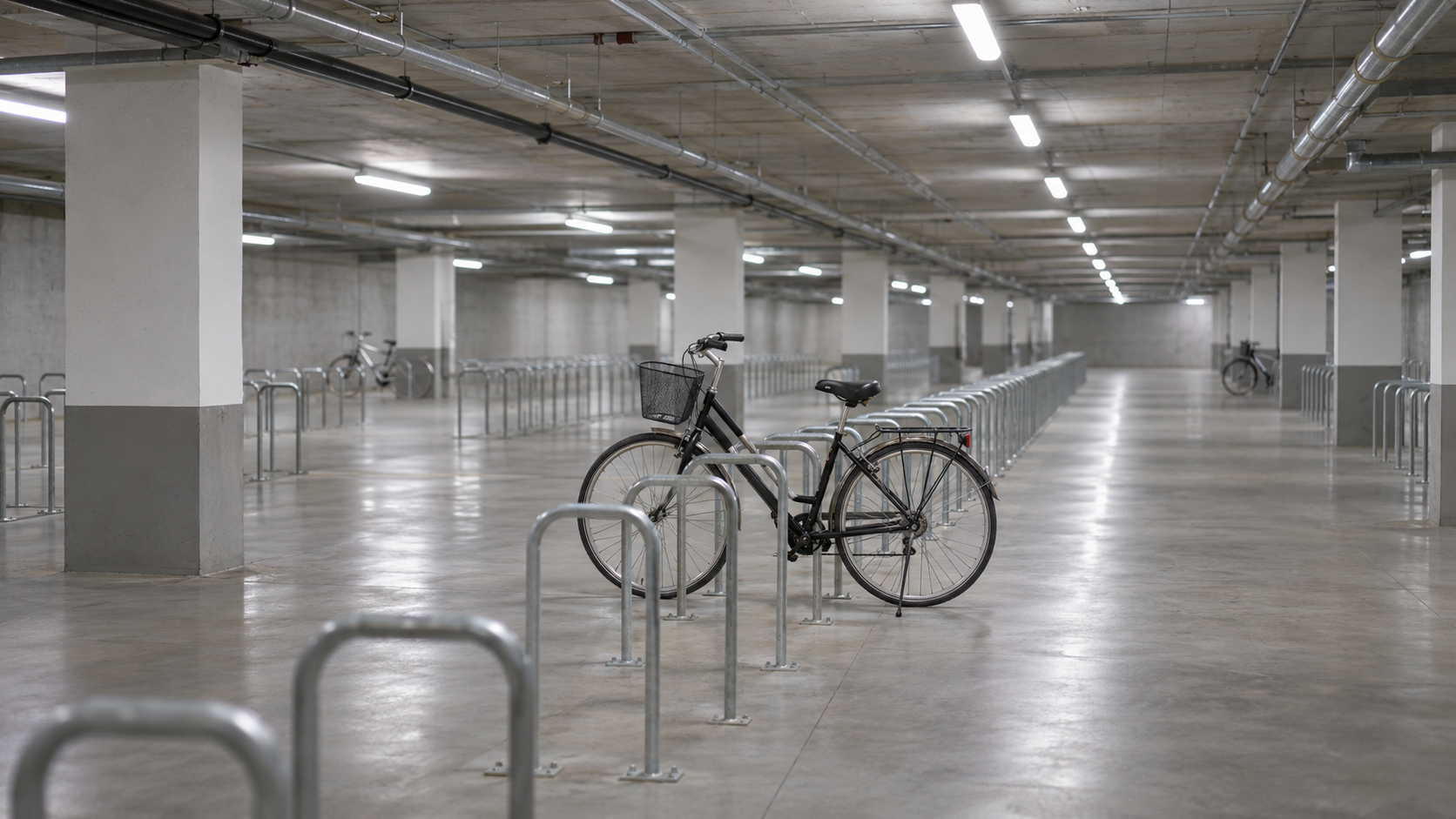
We’ve worked on developments with hundreds of bike spaces, and some with more than 1,000. When we go back after people move in, large parts of that capacity often sit unused. Even in cycling-friendly cities across North America, we’ve seen utilization as low as 25%.
We’ve also torn out bike rooms less than five years old because they didn’t work. They met code, but the layouts were so tight that 20 to 30% of the spaces were unusable. The strata paid for that room twice.
Don’t get us wrong. Cities are right to require bike parking. But “How many suites are in the building?” is a strange place to start.
Location Changes Everything
A building on a protected bike route is different from an identical building several kilometres from the nearest useful route. A residential tower next to rapid transit is different from a manufacturing plant with 20 employees. Hills, land use, local cycling rates, transit and the city’s own funded plans all shape real demand.
One commercial project we worked on in Oregon is a good example. The city’s formula required about 120 bike spaces, spread across several enclosed shelters. The site had fewer than 60 employees. It sat in an industrial area served by a highway and a local road busy with heavy trucks. There were no bike lanes, not even sharrows, and nothing in the city’s 5-to-10-year transportation plan to change that. $150,000 went into meeting code.
Was that the best way to advance cycling at that site, or in that region?
Plan for Funded Routes
Future demand matters. If a city has funded a protected bike corridor that will reach a development in two to five years, it makes sense to ask that project to plan for more riders. “Perhaps someday” is a different thing altogether.
We don’t have a perfect formula. A better one would start with a baseline and adjust it for location and for bike routes the city has actually funded. Where long-term demand is hard to predict, build enough capacity for opening day and leave room to add more. Then agree up front on the usage level that triggers the next phase.
There’s another option worth discussing. Let developers put part of that money toward finishing the missing bike connection to their site, instead of building spaces that may sit empty for a decade. It would need safeguards, so it doesn’t become a way to buy out of real obligations. The idea still deserves a hearing.
Measure What Gets Used
Minimums still matter. Without them, some projects would provide too little. The trouble is pretending one ratio can predict how people behave everywhere.
If cities are confident enough in their formulas to require major private spending, they should check the results. Go back two or three years after occupancy, count which spaces get used and which get avoided, and compare that with the assumptions made at approval.
If a 1,000-space project uses 300 spaces, that’s data. If a 300-space facility is always full, that’s data too. Good planning learns from both.
Any forecast will sometimes get the number wrong. That’s fine. What’s missing is anyone checking whether the rules are getting more people to ride.
We’re trying to use math to predict human behaviour. We should be using it to accommodate how people actually ride, and to encourage the kind of cycling we want more of.
Cheers!
The Kinetic Team
Planning a bike room?
Send us your layout. We’ll tell you which spaces will likely meet code but go unused, and what we’d change.